Clumio vs N2W: the alternative built for real recovery
Clumio backs up AWS data into a vendor-managed vault, meters your bill across GiB stored, millions of objects, and API requests, and ships no Azure protection today. N2W runs inside your own AWS, Azure, or GCP account at one flat rate, and fails over your VPCs, subnets, load balancers, and instances in 4 clicks.
| Capability | N2W | Clumio |
|---|---|---|
| One product for AWS, Azure, GCP, Wasabi | Yes | No |
| Backup copies stay in storage you control | Yes | No |
| Full environment failover in 4 clicks | Yes | No |
| VPC and network configuration restore | Yes | No |
| Flat rate, with no per-object fees | Yes | No |
| Compute scheduling to cut idle spend | Yes | No |
Clumio has its limitations
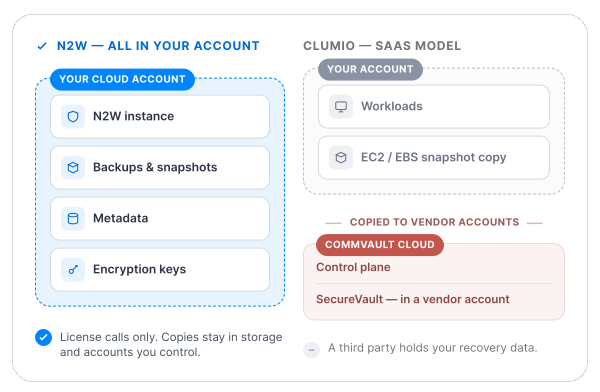
A third party vendor holds your recovery data in their vault
Clumio's control plane and the SecureVault both live in Commvault-owned AWS accounts, and your backup data is copied there by design.
- N2W runs as an EC2 instance or Azure VM inside your own environment, hardened to your security standards.
- N2W never takes custody of your data or keys, which reduces third-party data-custody exposure at the backup layer.
- N2W runs in AWS European Sovereign Cloud, operated inside the EU by EU citizens on its own IAM and billing, and in AWS and Azure GovCloud across every US Gov and DoD region.
Clumio's pricing has two meters running at once
Two buckets holding the same 100 TiB can cost very different amounts depending on how many objects are in them.
N2W vs Clumio: full feature comparison
Recovery means the whole environment
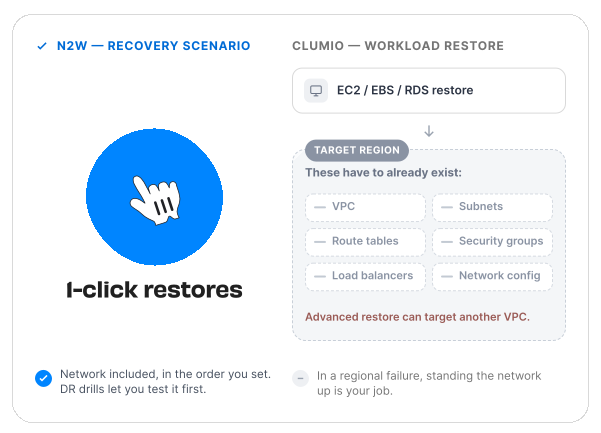
Networking resources aren't on Clumio's supported workload list, so VPCs, subnets, security groups, route tables, and load balancers aren't backed up.
- N2W captures the network with the workload.
- Recovery Scenarios bring resources back in the order you set.
- And you can schedule it to run as a DR drill to prove it works before you need it.
Find and fix what isn't protected in a few clicks
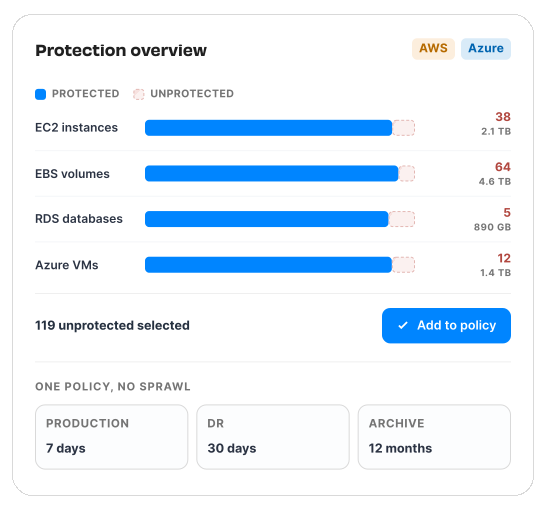
N2W's dashboard carries a protection widget, showing protected vs unprotected resources by type, count, and size. Select up to 200 unprotected resources and add them to a backup policy in one click. No tagging required.
- One policy holds daily, weekly, monthly, and yearly schedules, with separate retention for production, DR, and archive.
- On hourly schedules you can nominate the first backup of the day as the daily.
- Keep hourly backups for 24 hours and the daily for 7, inside one policy, with no policy sprawl to audit.
Clumio vs N2W: questions
What's the best Clumio alternative for AWS backup?
Depends what you're replacing it for. If it's cost predictability, look for flat-rate pricing that doesn't bill per object or per API request. If it's disaster recovery, look for something that backs up your network config and orchestrates failover, which Clumio doesn't. If it's Azure, look at almost anything else, because Clumio protects no Azure workloads. N2W covers all 3, deploys from AWS or Azure Marketplace, and never takes custody of your backup data. Veeam and Rubrik are worth a look if your estate is largely on-premises.
How much does Clumio cost per TB?
S3 SecureVault Standard is $0.025 per GiB-month, so roughly $25.60 per TiB-month, plus $1.50 per million managed objects per month. EC2 and EBS Standard is $0.045 per GiB-month, RDS Standard $0.14, DynamoDB $0.15 plus $0.02 per million items processed. The per-TB figure alone won't predict your bill, because object count, item count, and restore activity are metered separately. N2W charges a flat monthly rate per protected instance instead, so 100 GB and 100 TB cost the same.
Does Clumio charge for restores?
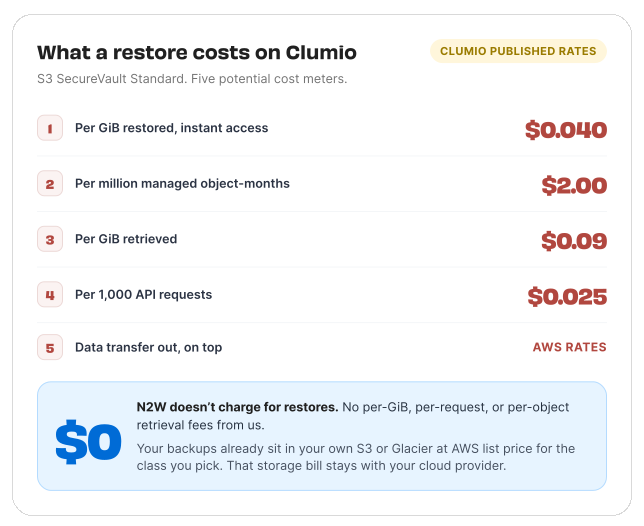
Yes, and the rates vary a lot by workload. S3 restore is metered on 4 published line items: $0.040 per GiB restored (instant access), $2.00 per million managed object-months, $0.09 per GiB retrieved, and $0.025 per 1,000 API requests, with data transfer out on top. Which of those apply depends on the restore you run. EBS is $0.020 per GiB. DynamoDB is $0.20 per GiB. RDS and Aurora Standard restores are free. N2W doesn't charge for restores at all, since the data is already sitting in storage you control.
Why is my Clumio bill higher than I expected?
Usually one of 3 things. Object count, because S3 and Google Cloud Storage carry a $1.50 per million managed objects per month fee that moves independently of data volume. Restore activity, because recovery carries its own meters on GiB restored, GiB retrieved, and API requests. Or early deletion, because SecureVault Archive holds a 6-month minimum on S3 and 12 months on RDS, with a fee if you delete sooner. Reviewers on G2 and PeerSpot flag billing visibility as their most common complaint.
Does Clumio support Azure?
Not today. As of August 2026, Clumio's supported workloads are AWS plus Google Cloud Storage, and Clumio's own workloads page lists Azure as "coming soon" with no ship date. Reviewers on G2 cite the gap as a reason it doesn't fit larger multi-cloud estates. Commvault does sell Azure protection through separate products in its wider platform, so check which product a quote actually covers. N2W protects AWS, Azure, and GCP from one console today, including Azure GovCloud, and restores across clouds in either direction.
Where does Clumio store my backup data?
In Commvault-owned AWS accounts. The SecureVault and the control plane both sit outside your account, and Clumio's security model treats that separation as the point, since a compromised customer account can't reach the vault. One nuance: for EC2 and EBS, Clumio also keeps a snapshot copy inside your account for incremental backups and fast operational recovery. N2W takes custody of nothing. The server is an EC2 instance or Azure VM you own, and copies land in storage and accounts you control, so we can't read your data.
Is Clumio still available after the Commvault acquisition?
Yes. Commvault completed the acquisition on 1 October 2024. It still sells as "Clumio by Commvault" with its own pricing page, docs, and Marketplace listing, and it's still shipping (Google Cloud Storage in June 2026, FedRAMP Moderate Ready in July 2026). Clumio support moved under Commvault support in June 2025. There's no published end-of-life or forced migration plan. One thing to factor into roadmap planning: Clumio retired its VMware and VMware Cloud on AWS products in September 2024, with customer data deleted after the final support date.
Can I back up on-premises workloads with Clumio?
No. Clumio is cloud-only and retired its VMware and VMware Cloud on AWS products in September 2024. If your estate is mostly on-premises, a platform like Veeam or Commvault's own on-prem products will fit better than either Clumio or N2W. N2W is cloud-native too: AWS, Azure, and Wasabi.
Does Clumio do disaster recovery, or just backup?
Backup and data recovery. The Clumio product has no documented multi-resource failover orchestration, no DR drill or dry-run capability, and no protection for VPCs, subnets, security groups, route tables, or load balancers. Its own EC2 restore docs note that a basic restore fails if the backup's VPC has since been deleted. Advanced restore can target a different VPC, subnet, region, or account, but that network has to already exist, because Clumio doesn't document backing it up or recreating it. Commvault positions environment rebuild under a separate product, Cloud Rewind, which is a different licence from Clumio. N2W orchestrates full failover and failback in 4 clicks with the network config included, and runs automated drills to test it, in one product.
How long do Clumio restores take for large S3 buckets?
Instant-access restores from SecureVault Standard start immediately. Archive Tier retrieval can take up to 48 hours. Clumio's own sources differ here: the docs say 12 to 48 hours, the pricing page says restore begins in 24 to 48 hours. A single restore operation covers up to 50 buckets. Reviewers on G2 report long restore times on larger datasets and limited progress visibility during big database restores. N2W restores from snapshots sitting in accounts you control, so there's no retrieval queue to wait on. "I had the servers back up and running literally within three minutes," says George Philippakos, Sr. Systems Analyst at St. John's.
What can N2W do that Clumio can't?
Restore the whole environment, network config included. Recovery Scenarios orchestrate multi-resource failover and failback in 4 clicks with VPCs, subnets, route tables, and load balancers restored alongside the workloads. Add Azure and GCP coverage, cross-cloud recovery that boots an AWS snapshot as a working Azure VM, automated DR drills, backup intervals as short as 60 seconds, Resource Control for scheduling compute down, your choice of any S3 or Glacier tier, and backup copies that stay in storage you control. All at a flat rate that doesn't move when your object count does.