AWS EBS offers persistent block level storage that is used with Amazon Elastic Compute Cloud (Amazon EC2) instances for persistent data storage. Additionally, EBS offers the option to create point-in-time EBS snapshots that are ideally used to back up and restore data to achieve DR capabilities.
If an AWS account owner wants to share data with another AWS account user, the account owner can share snapshots with the other AWS account. This is done by modifying snapshot permission attributes, which requires the AWS account ID of the other user. Users can obtain their AWS account IDs from their AWS account section. The other AWS account owner that you shared the snapshots with can create a new EBS volume in their AWS account, enabling them to have all of data from your EBS volumes in their account. It is important to note that users can share only unencrypted snapshots since encryption keys differ per AWS account.
In this article, we will show you how to share snapshots (EBS volume data backup) with other AWS account owners by modifying snapshot attributes.
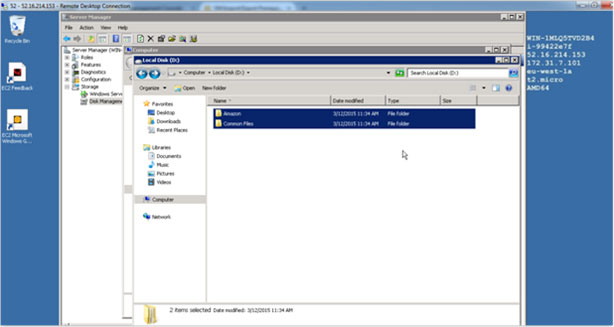
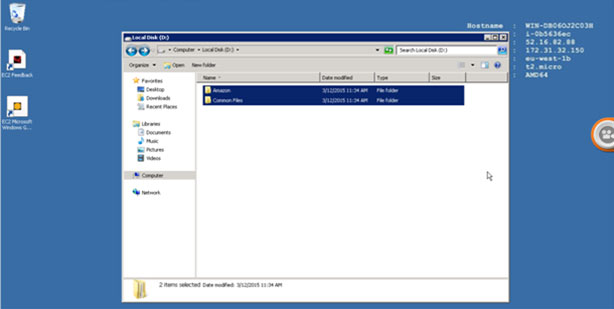
In the example below, we used a Windows 2012 instance with the following data:
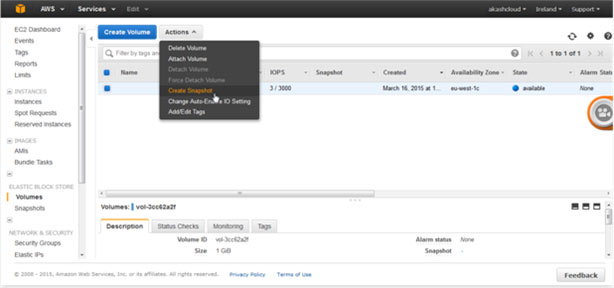
Next, create a snapshot from the previously created volume: Using the AWS CLI aws ec2 create-snapshot –volume-id vol-5be6ff47 –description “This is my data volume snapshot.”
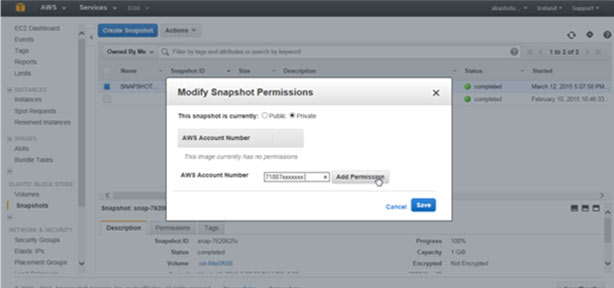
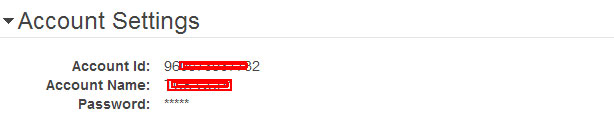
In order to share your snapshot with another AWS account, select ‘Modify Snapshot Permissions’ under the ‘Actions’ tab in your AWS console and enter the appropriate AWS account number. (Note: An AWS account ID is a 12-digit numeric code that you can find in your AWS account settings. Please refer to the following wizard for more details). Using the CLI [Modify Attribute]
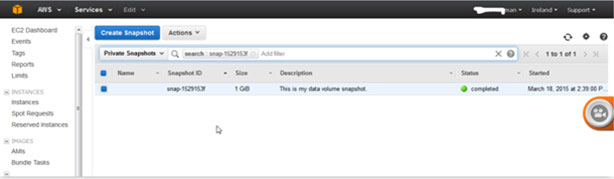
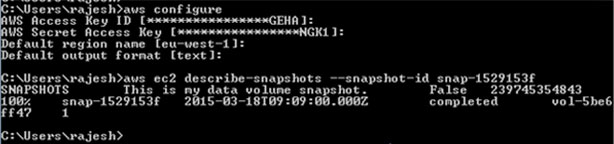
You can see if the snapshot was successfully shared with the other AWS account by logging into the other account and filtering according to ‘Private Snapshots’ and ‘Snapshot ID’.
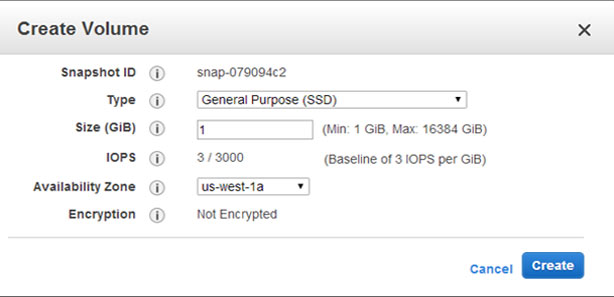
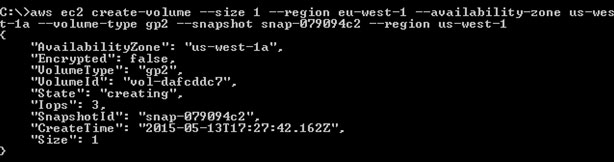
We have attached the new volume to an EC2 instance in the targeted account. In the following wizard, you can see that the data from the original AWS account is available in the target AWS account’s volume.
This article demonstrates how to copy data from one account to another account by sharing snapshots with a targeted account. It’s important to note that sharing snapshots is more secure, fast and cost-effective when compared to copying data using SCP or any other copy command from one account to another. It’s also important to note that when you share snapshots, all of the data on your EBS volume is shared with the other account. This may include secure data such as (kets, log files, etc.) so it’s important to remove secure content that you don’t want to share with the other user.
N2W offers a solution that enables you to further simplify the process of using snapshots. N2W is an enterprise-class backup-recovery and disaster recovery solution for the EC2 compute cloud. N2W is available as a service model that allows users to manage multiple AWS accounts and configure policies and schedules to take automated snapshot backups. It also has a Windows agent to consistently back up Windows applications. N2W allows you to recover a volume from a snapshot, increase its size and switch it with an existing attached volume, in a single step.
We use technologies like cookies to store and/or access device information. We do this to improve browsing experience and to show (non-) personalized ads. Consenting to these technologies will allow us to process data such as browsing behavior or unique IDs on this site. Not consenting or withdrawing consent, may adversely affect certain features and functions.
Functional
Always active
The technical storage or access is strictly necessary for the legitimate purpose of enabling the use of a specific service explicitly requested by the subscriber or user, or for the sole purpose of carrying out the transmission of a communication over an electronic communications network.
Preferences
The technical storage or access is necessary for the legitimate purpose of storing preferences that are not requested by the subscriber or user.
Statistics
The technical storage or access that is used exclusively for statistical purposes.The technical storage or access that is used exclusively for anonymous statistical purposes. Without a subpoena, voluntary compliance on the part of your Internet Service Provider, or additional records from a third party, information stored or retrieved for this purpose alone cannot usually be used to identify you.
Marketing
The technical storage or access is required to create user profiles to send advertising, or to track the user on a website or across several websites for similar marketing purposes.
To provide the best experiences, we use technologies like cookies to store and/or access device information. Consenting to these technologies will allow us to process data such as browsing behavior on this website. Not consenting or withdrawing consent, may adversely affect certain features and functions.
Functional
Always active
The technical storage or access is strictly necessary for the legitimate purpose of enabling the use of a specific service explicitly requested by the subscriber or user, or for the sole purpose of carrying out the transmission of a communication over an electronic communications network.
Preferences
The technical storage or access is necessary for the legitimate purpose of storing preferences that are not requested by the subscriber or user.
Statistics
The technical storage or access that is used exclusively for statistical purposes.The technical storage or access that is used exclusively for anonymous statistical purposes. Without a subpoena, voluntary compliance on the part of your Internet Service Provider, or additional records from a third party, information stored or retrieved for this purpose alone cannot usually be used to identify you.
Marketing
The technical storage or access is required to create user profiles to send advertising, or to track the user on a website or across several websites for similar marketing purposes.