What is Backup on AWS?
For dynamic workloads in AWS, characterized by rapid changes, auto-scaling, and high data velocity, effective backup strategies require automation, granular control, and low Recovery Point Objectives (RPOs). There are native AWS services and advanced third-party solutions that can help with these requirements.
Third-party backup solutions (AWS marketplace):
Third-party tools offer enhanced features used for more complex dynamic workloads. Popular solutions include:
- N2W software: Provides granular, second-level scheduling, cross-account/cross-cloud support, and advanced automation for EC2 and RDS.
- Veeam: Offers automated, policy-based backups, including application-consistent snapshots for complex applications.
- Rubrik: Provide specialized, automated backup and data management for hybrid, high-volume workloads.
AWS native backup options:
AWS offers managed services that automate the protection of data across multiple services.
- AWS backup: A central service to configure, schedule, and monitor backups for Amazon EBS, EC2, RDS, DynamoDB, EFS, and Storage Gateway. It supports tag-based policies, allowing new, dynamically created resources to be automatically included in backup plans.
- AWS data lifecycle manager (DLM): Used to automate the creation, retention, and deletion of Amazon EBS snapshots and EBS-backed AMIs based on tags.
- Amazon S3 replication (CRR/SRR): Provides continuous, real-time, asynchronous copying of objects to different regions or accounts, ideal for dynamic data storage.
- AWS backup audit manager: Tracks backup activities and provides compliance reporting to ensure that dynamic, ephemeral resources are actually being backed up.
In this article:
- What are Dynamic Workloads and What Special Concerns Do They Have?
- What Are the Top AWS Services Where Dynamic Workloads are Deployed?
- Third-Party AWS Backup Solutions for Dynamic Workloads
- AWS Native Backup Options for Dynamic Workloads
- Strategies for Dynamic Workloads on AWS
What are Dynamic Workloads and What Special Concerns Do They Have?
Dynamic workloads are cloud-based applications or services that automatically scale resources up or down in response to changing demand. This elasticity is a core feature of cloud-native architectures and is often driven by auto scaling groups, serverless functions, or container orchestration platforms like Kubernetes.
These workloads are typically decoupled and distributed. Rather than being built as a single monolithic application, they are composed of smaller, independent components, often microservices, communicating over APIs. This makes them more resilient and scalable but also adds complexity in tracking state and dependencies during backup and restore operations.
Dynamic workloads also change frequently. Resources may be created, modified, or terminated automatically as part of CI/CD pipelines or infrastructure as code (IaC) deployments. This rapid churn means that backup strategies must be automated and policy-driven, rather than relying on manual configuration. Backup policies must dynamically discover and protect new resources as they appear.
One of the key challenges in backing up dynamic workloads is that they’re harder to “snapshot.” Unlike static systems where the infrastructure and data state remain consistent over time, dynamic environments have ephemeral components whose states can shift from minute to minute. This requires more frequent backups, shorter RPOs, and tools capable of capturing data across distributed services without assuming a fixed architecture.
What Are the Top AWS Services Where Dynamic Workloads are Deployed?
Dynamic workloads in Amazon Elastic Kubernetes Service (EKS) are typically composed of containerized microservices that are deployed, scaled, and terminated automatically based on demand. Backup strategies in EKS need to account for both the persistent data (e.g., volumes attached to pods) and the cluster state (e.g., deployments, services, and config maps). Tools like Velero or AWS Backup with EBS integration can capture persistent volume data, while GitOps practices or IaC tools like Helm or Terraform are often used to restore cluster configurations. Backup solutions must be able to identify and track dynamically changing namespaces, volumes, and node groups.
AWS Lambda
AWS Lambda functions are inherently ephemeral and stateless, but they often process or trigger events tied to dynamic data sources like S3, DynamoDB, or SQS. Backup strategies for Lambda-based workloads focus more on protecting the associated data and configuration artifacts (function code, environment variables, IAM roles, and event source mappings). AWS CloudFormation or the AWS Serverless Application Model (SAM) can be used to capture infrastructure as code. Regular exports of function definitions and versioning are essential to ensure rapid recovery in case of accidental deletion or deployment errors.
Amazon EC2 with Auto-scaling Groups
Auto Scaling Groups (ASGs) launch and terminate EC2 instances based on defined policies, making the set of active resources highly dynamic. Since ASG instances are frequently replaced, backups focus on the underlying launch templates, configuration files, and persistent storage like EBS volumes. AWS Backup and DLM can automate snapshots of EBS volumes using tag-based policies. Backup strategies should also capture golden AMIs used in the launch configurations, along with any instance-specific data that isn’t stored in shared volumes or external databases.
Serverless AWS Workloads
Serverless architectures often combine multiple managed services—such as Lambda, API Gateway, Step Functions, DynamoDB, and S3—into a loosely coupled application. Backing up these workloads requires a multi-service approach. Each component’s state and configuration must be captured, along with data persistence layers like DynamoDB tables and S3 buckets. DynamoDB PITR and S3 replication are commonly used. Tools that support IaC or application templates (e.g., AWS CloudFormation StackSets) help preserve architecture definitions, while centralized services like AWS Backup can handle data protection where supported.
Third-Party AWS Backup Solutions for Dynamic Workloads
1. N2W

N2W is a cloud-native backup and disaster recovery platform purpose-built for dynamic AWS environments. Unlike snapshot-only tools, N2W combines policy-driven automation, cross-account isolation, immutability, and full-environment recovery orchestration into a single console. It runs directly inside your AWS account using secure API calls, so you retain full control of your data, keys, and permissions.
For IT SysAdmins and Cloud Engineers managing EKS clusters, multi-account architectures, or compliance-driven workloads, N2W focuses on making backup ridiculously easy, recovery seriously fast, and ransomware protection highly secure, without inflating storage costs.
Key features include:
- Cross-Account & Cross-Region Isolation: Create a dedicated DR account to isolate backups from production, reducing blast radius and protecting against accidental or malicious deletion.
- Immutable Backups & Compliance Locking: Enforce tamper-proof backup retention policies to prevent modification or deletion (even by admins) supporting ransomware resilience and regulatory compliance.
- Full Environment Recovery Orchestration: Restores complete environments—including VPCs, subnets, routing tables, VPNs, load balancers, and security groups—in the correct boot order.
- AWS EKS Backup & Recovery: Provides policy-driven protection for EKS namespaces and clusters with flexible restore to the same or a different cluster for rollback or migration scenarios.
- Unified Multi-Account & Multi-Cloud Management: Manages AWS, Azure, and Wasabi backups from a single console without switching tools or workflows.
- Granular Scheduling & Tag-Based Automation: Supports second-level scheduling precision and dynamic inclusion of resources using tags (ideal for auto-scaling and ephemeral workloads).
- One Policy, Multiple Retentions: Enables weekly and monthly retention schedules within a single policy to reduce backup sprawl and optimize storage usage.
- Cost Optimization Controls: Includes snapshot archiving, lifecycle automation, run-now cleanup, and resource scheduling to prevent storage overprovisioning.
- Automated DR Drills: Runs non-disruptive recovery scenarios to validate disaster readiness without impacting production workloads.
- Granular & File-Level Restore: Restores individual files, folders, volumes, or full instances without requiring full-environment recovery.
- Runs Inside Your AWS Account: Operates through secure API calls within your own AWS environment, ensuring full data control and sovereignty.
N2W and AWS Backup differ most on recovery and archiving. Compare them side by side.
2. Veeam AWS Backup and Recovery

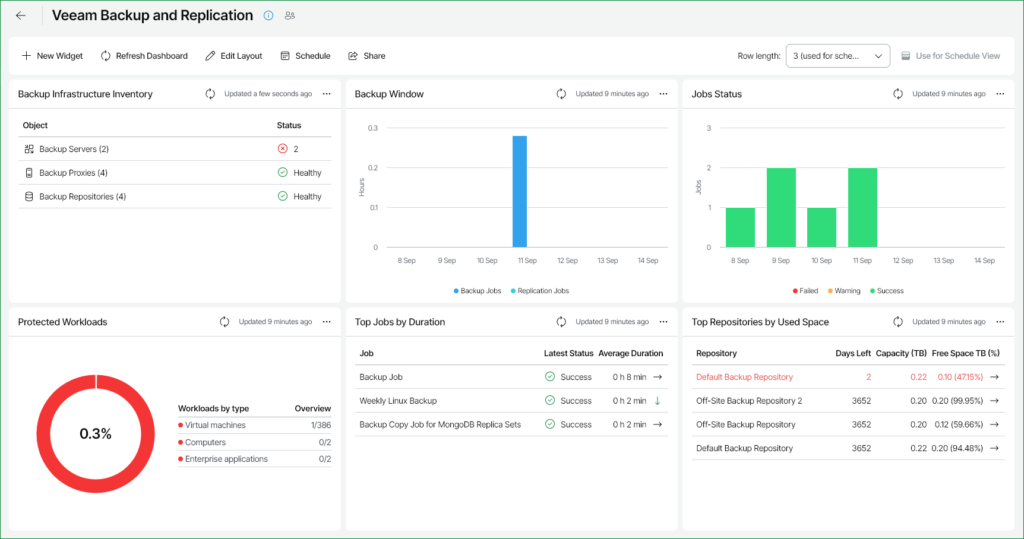
Veeam Backup for AWS provides an alternative to native AWS backup tools, offering additional control, security, and flexibility for dynamic cloud environments. It uses policy-based automation to detect and protect AWS workloads, such as EC2 instances, RDS databases, and Amazon VPC configurations, without requiring manual scripting or intervention.
Key features include:
- Immutable and Encrypted Backups: Supports WORM state and encryption to protect backup data integrity
- Logical Air Gap: Separates backup data from production environments to prevent cross-contamination
- Secure Access Controls: Implements least-privilege IAM and RBAC for secure management
- Cross-Platform Recovery: Enables restores across AWS accounts, regions, and other supported platforms
- Granular and Full Recovery: Offers full instance recovery and file-level restore options
3. Rubrik AWS Backup and Recovery

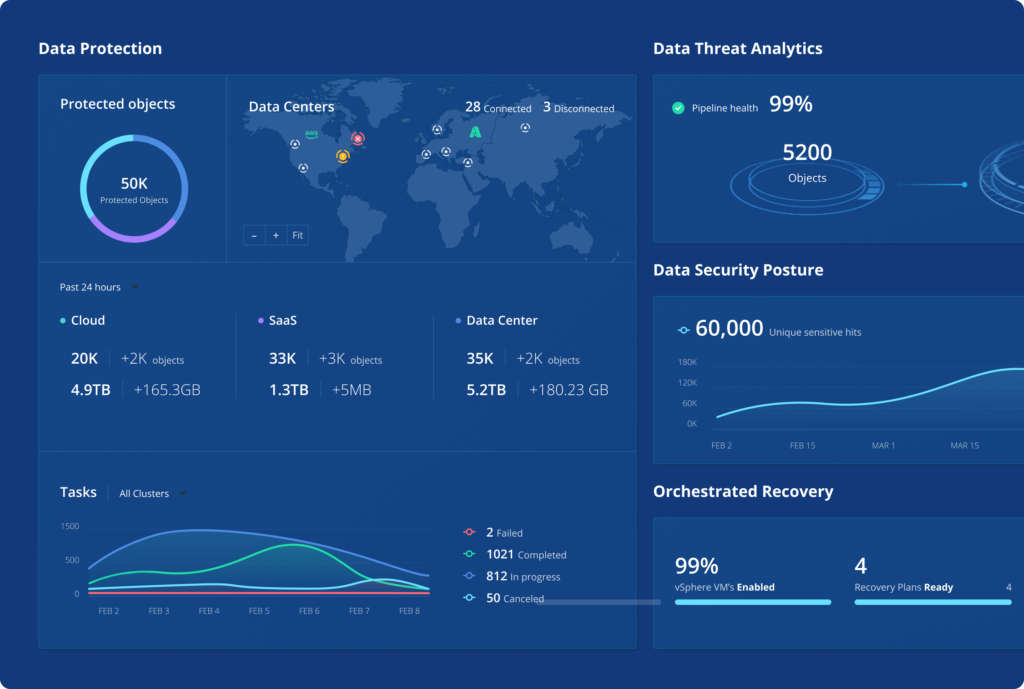
Rubrik offers a cloud-native solution designed to simplify and automate data protection across AWS environments, hybrid clouds, and AWS Outposts. It provides unified management of both on-premises and AWS workloads using policy-driven automation. Rubrik supports rapid recovery with near-zero RTOs and RPOs, ensuring minimal downtime for dynamic workloads.
Key features include:
- Policy-Driven Automation: Centralized management through global policies that simplify backup, retention, and recovery
- Fast Recovery: Supports near-zero RTOs and RPOs for mission-critical workloads
- Native AWS Protection: Directly protects workloads on AWS, including virtual machines and SaaS applications
- S3 Data Protection: Streamlined discovery, backup, and recovery of Amazon S3 data through a single interface
- Application Mobility: Facilitates long-term retention, test/dev cloning, or workload migration across environments
4. MSP360 for AWS

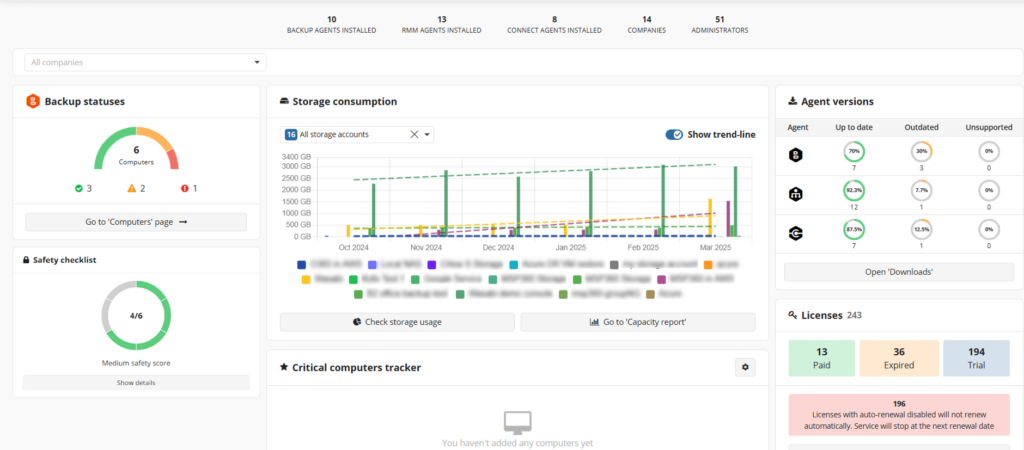
MSP360 Managed Backup integrates directly with Amazon S3 to deliver a scalable, cost-effective backup solution for managed service providers (MSPs) and businesses. The platform offers centralized management, monitoring, and reporting across a range of workloads including Windows, Linux, macOS, VMware, Hyper-V, Microsoft 365, and Google Workspace.
Key features include:
- Native AWS Integration: Built-in support for Amazon S3 as a backup destination across all major storage classes
- Centralized Management: Unified dashboard for backup configuration, monitoring, and reporting
- Immutability Support: Protects backups from deletion or modification during a defined retention period
- Synthetic Full Backups: Minimizes data transfer by creating full backups using existing data in Amazon S3
- Flexible Storage Options: Choose between bring-your-own S3 or use MSP360 storage with flat-rate pricing
5. Acronis AWS EC2 Backup and Disaster Recovery

Acronis Cyber Protect provides an integrated solution for backup, disaster recovery, and cyber protection for Amazon EC2 instances. It combines automated backup scheduling, rapid recovery, and advanced threat defense into a single platform designed for both enterprises and managed service providers. The platform supports application-consistent backups, encryption, and ransomware protection using immutable storage.
Key features include:
- Comprehensive EC2 Backup: Protects data, system state, and applications running on AWS EC2
- Flexible Scheduling: Supports custom and automated backup schedules tailored to workload patterns
- Incremental & Differential Backups: Reduces storage use and bandwidth by backing up only changed data
- AES-256 Encryption: Secures data in transit and at rest for compliance and privacy
- Ransomware-Proof Storage: Uses immutable storage to prevent unauthorized deletion or encryption of backups

AWS Native Backup Options for Dynamic Workloads
6. AWS Backup
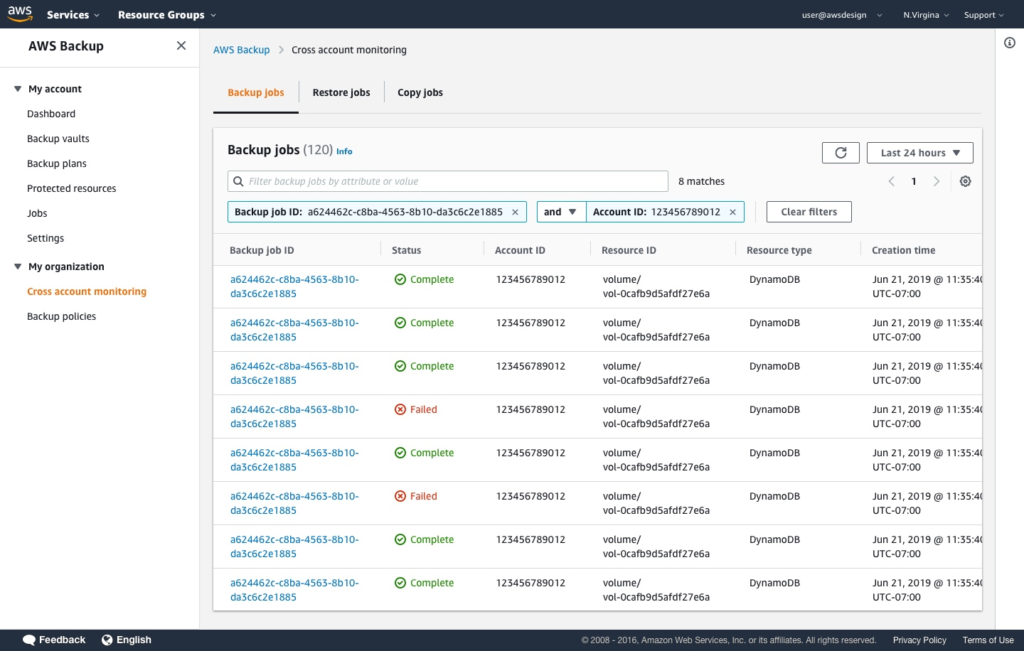
AWS Backup is a fully managed service that centralizes and automates the backup of data across AWS services such as Amazon EBS, Amazon RDS, Amazon DynamoDB, Amazon FSx, and AWS Storage Gateway. It provides policy-based backup management, supporting scheduling, retention, and lifecycle rules that suit dynamic resource allocation and deprovisioning. This helps organizations consistently protect changing workloads without manual intervention or complex scripting, making the backup process reliable and repeatable.
The service includes features such as backup vaults for logically separating backup data,
cross-region backup for disaster recovery, and built-in compliance auditing. AWS Backup’s integration with AWS Organizations allows businesses to implement consistent backup strategies across multiple accounts, making it well-suited for modern cloud environments that frequently spin up and down resources based on demand.
7. AWS Data Lifecycle Manager
AWS Data Lifecycle Manager (DLM) automates the creation, retention, and deletion of snapshots for Amazon Elastic Block Store (EBS) volumes. With DLM, organizations can define lifecycle policies based on resource tags, automating the backup and retention of data for dynamic instances that commonly appear and disappear in auto-scaling environments.
This automation reduces manual oversight and ensures adherence to organizational backup policies even as resources change. The lifecycle management helps control costs and storage sprawl by automatically deleting outdated backups following retention rules. These features support the integrity of rapidly changing environments where instance lifespans are unpredictable, and adherence to backup schedules can otherwise become inconsistent or error-prone.

8. Amazon S3 Replication
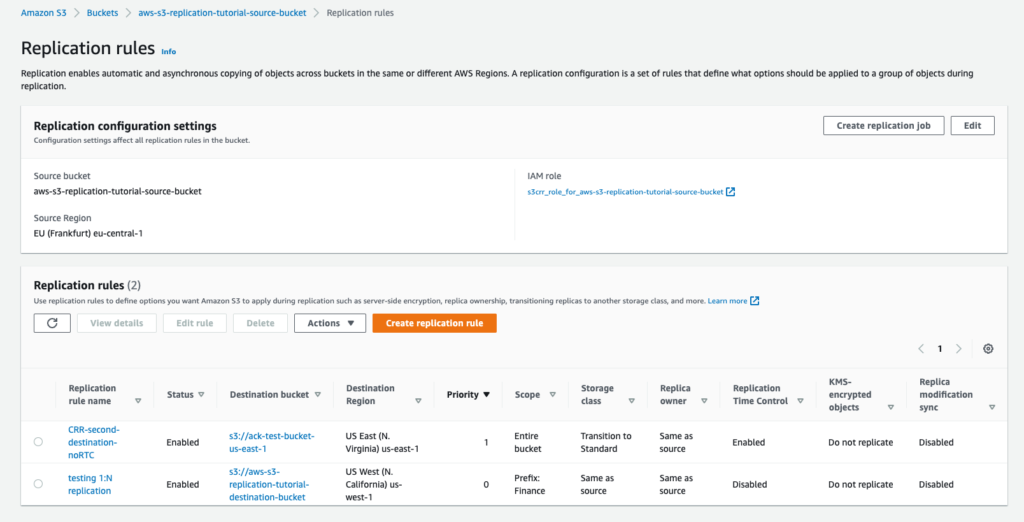
Amazon Simple Storage Service (S3) offers replication features to automate the copying of objects across buckets, accounts, or AWS regions. S3 Replication supports both same-region and cross-region options, allowing organizations to enhance data durability, comply with regulatory requirements, and enable disaster recovery. This is particularly beneficial for workloads generating and modifying large volumes of data, as S3 Replication can provide near real-time backup copies.
With dynamic workloads, where objects are constantly added or modified, S3 Replication ensures backup copies keep pace with the primary data set without manual intervention. Built-in features—such as replication metrics, delete marker replication, and versioning—greatly streamline ongoing management for workloads with unpredictable data change rates.
Strategies for Dynamic Workloads on AWS
Tag-Based Automation
Tag-based automation enables organizations to dynamically manage backup operations based on metadata assigned to AWS resources. By using resource tags such as Environment=Prod or Backup=true, backup tools—like AWS Backup and AWS Data Lifecycle Manager—can automatically include or exclude resources in backup policies without manual updates.
This is especially useful in auto-scaling or ephemeral environments where instances and volumes are frequently created and terminated. Tag-based rules ensure that all newly launched resources meeting specified criteria are automatically protected, improving consistency and reducing operational overhead.
Incremental Backups
Incremental backups capture only the data that has changed since the last backup, reducing backup time, storage usage, and network bandwidth. AWS services such as Amazon EBS snapshots, AWS Backup, and third-party tools like Veeam or MSP360 support incremental backup mechanisms.
For dynamic workloads with frequent data changes, incremental backups offer an efficient and cost-effective method to maintain data protection without repeating full backups. They also enable faster restores and support tighter recovery point objectives (RPOs), which are critical for high-change-rate environments.
Lifecycle Management (Cold Storage)
Lifecycle management automates the transition of backups and snapshots to lower-cost storage classes over time, such as Amazon S3 Glacier or Glacier Deep Archive. Services like AWS Backup and S3 lifecycle policies support automatic tiering based on age or access frequency.
For dynamic workloads generating frequent backups, lifecycle rules help control storage costs by archiving older, less-accessed backups while retaining them for compliance or audit purposes. This approach supports long-term retention without overwhelming active storage capacity or incurring unnecessary expenses.
Cross-Account/Region Backup
Cross-account and cross-region backup strategies enhance resilience by isolating backup data from the primary environment. AWS Backup supports backup copy jobs across regions and AWS accounts, helping protect against localized failures, security breaches, or accidental deletions.
This separation is critical for dynamic workloads, where resource turnover is high and the risk of operational errors increases. By storing backups in different accounts or regions, organizations reduce blast radius, improve disaster recovery posture, and meet data sovereignty or regulatory requirements.
Backup Orchestration with Infrastructure as Code
Infrastructure as code (IaC) tools like AWS CloudFormation, Terraform, and Pulumi allow backup configurations to be defined and versioned alongside application infrastructure. By embedding backup policies and resource tagging directly in IaC templates, teams can enforce consistent backup practices as part of the deployment process.
This is especially beneficial for dynamic workloads where infrastructure is frequently spun up and torn down. Automating backup policy application ensures new resources are protected by default, without relying on manual intervention or post-deployment scripts. It also improves auditability and repeatability across environments, supporting better compliance and operational hygiene.
Conclusion
Protecting dynamic workloads on AWS demands more than traditional backup strategies. The transient nature of cloud-native infrastructure, frequent data changes, and automated scaling require tools and practices that are policy-driven, tag-aware, and tightly integrated with infrastructure provisioning.
By combining native AWS services with advanced third-party solutions, organizations can maintain resilient and auditable backup strategies that scale with their environments. Implementing automation, cross-region isolation, and infrastructure-as-code orchestration ensures that data protection keeps pace with even the most dynamic workloads.